Monday, April 30, 2007

Handling reading material

Staying on top of things in our field means we must stay on top of professional reading. In addition, to professional journals, we all have the things we simply like to read for pleasure. How can we manage it all?

My last post talked about listening to books on tape as a substitute for some of print material. That still leaves me with a great deal of reading material.

I have a section of my briefcase devoted to reading material. As I am going through the mail at work or at home, magazines go straight into the briefcase. That one simple act keeps all of my awaiting reading material in one place. There is no doubt between what has been read and what has not. Anything in the briefcase is either unread or partially read.

When I have down time, I simply pull out something from the briefcase. That means if I am waiting to see the doctor or dentist or if I am waiting to get my hair cut, I pull out some of my reading material. On the way home, I am frequently stopped by a train—so, out comes reading material. I tend to get to appointments early, and while I am waiting, I have reading material.

In short, I match reading material with time that would otherwise be wasted. It keeps the reading material from building up and keeping me from getting bored.

Saturday, April 28, 2007

Commute time

Like many of you, I have a bit of a commute to work. Mine is 23 minutes, small in comparison to many people, but gargantuan compared to the 3 minute drive to work from my early days in teaching. For the last year, I have turned what had been wasted time into an enjoyable and productive daily experience.

For the past year, I have never been without a book on tape or CD from the public library. The number of books I have experienced during that time numbers several dozen, and that is a conservative estimate. The latest has been The World is Flat. Listening to all 15 or 16 CDs kept me busy for quite a while, and proved to be fastinating listening. Of course, I have always been aware of the availability of audiobooks. Up until the last year, I had simply never made regular trips to the library for them a priority.

In today's world, lifelong learning is essential. Books are the shortcut to that learning. Their authors have carefully honed and summarized a body of knowledge into a coherent message. At the same type, the pace of today's world makes time for reading hard to find. Making commute time do double-duty has been a simple answer, and easy enough I will actually do it.

Thursday, April 12, 2007

Office update: the problem and the fix

I ran the Office Update earlier this week, a good thing. Afterwards, I realized I could not open my saved searches. Each time, I would get an error message. I also could not re-create them. They would not save.

A Google search put me onto this explanation and the solution.

The workaround presented in the article is as follows:

Warning Serious problems might occur if you modify the registry incorrectly by using Registry Editor or by using another method. These problems might require that you reinstall the operating system. Microsoft cannot guarantee that these problems can be solved. Modify the registry at your own risk.

To work around this problem, re-enable the Office Saved Searches feature. To do this, follow these steps:

Exit Outlook.

Click Start, click Run, type regedit, and then click OK.

Locate and then click one of the following registry subkeys:

HKEY_CURRENT_USER\Software\Microsoft\Office\11.0\Outlook\Options\General

HKEY_CURRENT_USER\Software\Microsoft\Office\10.0\Outlook\Options\General

HKEY_CURRENT_USER\Software\Microsoft\Office\9.0\Outlook\Options\General

Note If the General subkey does not exist, follow these steps to create the subkey:

Click the Options subkey, point to New on the Edit menu, and then click Key.

Type General, and then press ENTER

On the Edit menu, point to New, and then click DWORD Value.

Type EnableOfficeSavedSearch, and then press ENTER.

Right-click EnableOfficeSavedSearch, and then click Modify.

In the Value data box, type 1, and then click OK.
Note To disable this feature, type 0 in the Value data box. Or, delete the registry key that is mentioned in step 3.

On the File menu, click Exit.

I followed the directions, and my searches were working again!

I was wondering if this problem was just a bug or if Microsoft did this on purpose. I posed the question to an Outlook discussion group and was directed to this explanation. When you reach that site, Expand Vulnerability Details>Microsoft Outlook Advanced Find Vulnerability. I hope a future patch fixed the security problem while still allowing saved searches. Explaining to someone fairly new to Outlook how to set up a saved search is challenge enough. Having to explain how to change the registry is too much!

Wednesday, April 11, 2007

Creating Outlook Saved Searches

I have three “saved searches” which I have created in Outlook

Task has not been completed and information I am looking for is in the subject line

  • Create a new “Advanced Find.” (Ctrl+Shift+F).
  • Change the “Look for” drop-down box to read “Tasks.”
  • On the “In” drop-down box, choose “subject field only.”
  • Click the “Advanced” tab.
  • On the “Field” drop-down box, choose “Frequently-used fields” and then “Complete.”
  • The “Condition” drop-down box should read “equals” and “Value” should be “No.”
  • Click “Add to List.”
  • From the “File” menu, select “Save Search.”
  • Assign a name to the search.
  • Select a place to save it. Since I use these searches often, I save them to the desktop. Since I use this particular one the most of all, I drug mine to the taskbar at the bottom of the screen so that it is always visible.

    Task has not been completed and information I am looking for is in the note section
    Create a new “Advanced Find.” (Ctrl+Shift+F).
  • Change the “Look for” drop-down box to read “Tasks.”
  • On the “In” drop-down box, choose “subject and notes field.”
  • Click the “Advanced” tab.
  • On the “Field” drop-down box, choose “Frequently-used fields” and then “Complete.”
  • The “Condition” drop-down box should read “equals” and “Value” should be “No.”
  • Click “Add to List.”
  • From the “File” menu, select “Save Search.”
  • Assign a name to the search.
  • Save to the desktop.


    Task has been completed
  • Create a new “Advanced Find.” (Ctrl+Shift+F).
  • Change the “Look for” drop-down box to read “Tasks.”
  • On the “In” drop-down box, choose “subject and notes field.”
  • Click the “Advanced” tab.
  • On the “Field” drop-down box, choose “Frequently-used fields” and then “Complete.”
  • The “Condition” drop-down box should read “equals” and “Value” should be “Yes.”
  • Click “Add to List.”
  • From the “File” menu, select “Save Search.”
  • Assign a name to the search.
  • Save to the desktop.

    The search I use by far the most often is the first one. If someone walks in my office or calls my on the phone, I can click the icon on the taskbar for that saved search, type the person’s name in the “Search for the words(s)” line, and click “Find Now.” Everything I need to talk to that person about, regardless of when it is due, is not displayed.

    With these three saved searches and using the appropriate one for the information I am trying to find, I get my results much more quickly. When we compare the advantage/disadvantages of organizing digitally versus paper/pencil, one area where the digital system wins out is the ability to search data. We need to maximize that capability, and the “saved search” is one of those ways.

Tuesday, April 10, 2007

Outlook Saved Searches

Sometimes, we do not fully appreciate something until we face the prospects of not having it anymore. Such is the case of the “saved searches” I created on Outlook. For about 20 minutes yesterday, I could not access them and could not re-create them. I was able to determine the problem and the fix. In my two posts, I will share how to create saved searches, tehe prolem I encountered, and the solution.

The prospect of not having them and realizing how valuable they are to me prompts me to write this post. If you organize with Outlook, they such might be as valuable to you.

I use several “saved searches” to search my Outlook Task list. Why would I need to search the task list?

  1. To satisfy myself that I had indeed put a particular task on the list, even if the start date was not to occur for months.
  2. To find a particular item that I just know I put on the list but somehow don’t see it.
  3. To find a piece of information that I know I put in the note section of a Task but may not remember how I had worked the subject of the Task.
  4. To find a piece of information either in the subject line or note section of Task that I had completed sometime in the past.

We can at anytime perform a search (Tools>Find>Advanced Find or Ctrl+Shift+F) So, why do I need special “saved searches”? The answers might sound trivial, but when you use this valuable tool as much as I do, saving a few keystrokes and 30 seconds a shot adds up. Before I begin a search, there are generally a few things I know about that search. Having a “saved search” allows me to narrow the search from the beginning, this saving me considerable time. This example should make the explanation clearer.

When I go to search for a piece of information that is somewhere in Tasks, I have a good idea of the following:

  1. Whether it is a piece of information in a task completed in the past or whether the information is contained in a Task not yet completed. Since searching all Tasks takes longer than searching Tasks not yet completed, it would be nice to have a “saved search” that searches for Tasks which have been completed and another for Tasks which have not been completed.
  2. Whether the information is in the subject line of the Task or in the attached note. Searching just the subject line is much quicker. Searching just the subject line of the Tasks not completed really saves time over searching every Task in Outlook.

In my next post, I will discuss how to construct saved searches. In the post which follows that, I will describe the problem caused by an Office Update and how to fix it.

Monday, April 02, 2007

Gone Phishing!

A couple of posts ago, I talked about how easy it is to tell whether an e-mail you are getting is for real or a hoax. Just highlight and copy a hunk of text from the message and paste it into Google. A couple of days ago, I received the message pasted below. My first thought was that I was going to be spending some time trying to figure out who had charged something to my account.

I saved myself quite a bit of time and frustration by taking a couple of seconds to simply practice what I preach. The text I chose to highlight and copy was the "Transcation ID"--which was "2LC956793J776333Y." Pasted that string into Google gave me a whole page of hits , each one making it obvious that the whole thing was not only a hoax, but a phishing scheme. What the culprit wanted was for me to click on a certain link as quickly as possible to "report" the false charge to PayPals. The result would have been I would have been asked for information that would then have resulted in identity theft.


Dear PayPal Member,
This email confirms that you have sent an eBay payment of $43.78 USD to
andrew2091 <mailto:andrew2091@aol.com&YY=24663&order=down&sort=date&pos=0&view=a&amp;head=f> @aol.com <mailto:andrew2091@aol.com&YY=24663&order=down&sort=date&pos=0&view=a&head=f> for an eBay item.
-----------------------------------
Payment Details
-----------------------------------
Amount: $43.78 USD
Transaction ID: 2LC956793J776333Y
Subject: Digimax 130
Note:
If you haven't authorized this charge ,click the link below to dispute transaction
and get full refund
Dispute transaction <http://www.purehavok.com/us/> (Encrypted Link )
*SSL connection:
PayPal automatically encrypts your confidential information
in transit from your computer to ours using the Secure
Sockets Layer protocol (SSL) with an encryption key length
of 128-bits (the highest level commercially available)
-----------------------------------
Item Information
-----------------------------------
eBay User ID: scratchandgnaw2
----------------------------------------------------------------
Andrew Harrell's UNCONFIRMED Address
----------------------------------------------------------------
Andrew Harrell
211 David St.
Springtown, TX 76082
United States
Important Note: Edward Harrell has provided an Unconfirmed Address. If
you are planning on shipping items to Edward Harrell, please check the
TransactioYn Details page of this payment to find out whether you will
be covered by the PayPal Seller Protection Policy.
----------------------------------------------------------------
This payment was sent using your bank account.
By using your bank account to send money, you just:
- Paid easily and securely
- Sent money faster than writing and mailing paper checks
- Paid instantly -- your purchase won't show up on bills at the end of
the month.
Thanks for using your bank account!
------------------------Y----------------------------------------
Thank you for using PayPal!
The PayPal Team
PayPal Email ID PP127

Monday, March 26, 2007

Bless are they who “bcc”

Today I received yet one more of those one-line e-mail messages that was sent to 130 other people. Of course, you know what happens when you print that message or forward that message to someone else, right? The one-line message is preceded by 130 e-mail addresses.

The solution to this problem is so simple. When sending to a message to a large number of people, instead of putting them in the “To” line, put them in the “Bcc” line. Everyone still gets the message, only they will not get the e-mail addresses of everyone else to whom the e-mail was sent. Just a quick solution to another one of life’s little annoyances.

Saturday, March 17, 2007

Run for your life! It's a hoax!

"Want a free computer? Just forward this e-mail to 8 people." Not only did someone send me that e-mail this week, but it's the third time in the last few weeks I have gotten the same one. Shouldn't I forward it to my entire address book just in case it's for real? Well...no. It's a hoax. Two things tell me that:
  1. Common sense. (Come on. Why in the world would anybody be giving away free computers for just forwarding an e-mail?)
  2. A quick little copy and paste into Google. It takes all of five seconds, and armed with this simple technique, you can figure out which e-mails are on the up-and-up and which are hoaxes.

Here is all you need to do:
  1. Highlight a hunk of text from the e-mail and use the Copy command (Control-C).
  2. Go to Google.
  3. Click in the search line and use the paste command (Control-V).
  4. Hit enter.
  5. Sit back and watch the fireworks. You are going to get hits that tell you instantly whether or not you have hooked a hoax.

Aren't Hoaxes Just Simple, Harmless Fun?
If you call wasting your own work time, contributing the problem of junk e-mail in everyone's in-box, and clogging up your employer's server simple, harmless fun, I guess you have a good point.

Other hoaxes are actually more harmful. Take, for example, the Teddy Bear Hoax. Readers were warned about a virus and told how to search for a particular file. If the file was present, the computer was infected. The e-mail would go on to explain how to get rid of the infected file. Finally, the e-mail would ask that people forward the e-mail to everyone else.

It seemed everyone receiving the e-mail was finding that yes indeed, they did have this suspect file on their computer. Well, there was good reason everyone was finding they have that file...everyone is supposed to have that file! It's a part of Windows and serves a very good function! (Now the problem was figuring out how to get the deleted file back again.)

One particular school system found that the Teddy Bear Hoax had been circulated widely before it came to the attention of it's tech support folks. Pretty frantic notices went out for people to stop forwarding the hoax and not to delete the file described in the e-mail.

Being Part of the Solution
Whenever I get one of these suspect e-mails, the drill I follow is:
  1. Under no circumstances add to the problem by forwarding the thing
  2. Use the "copy-Google-paste" routine I described earlier.
  3. Copy the URL of one of the sites that explains the hoax.
  4. Go back to the e-mail and hit "Reply."
  5. Paste the URL into the message.
  6. Just above the link, I generally include the message, "Run for your life! It's a hoax!"
  7. Hit "Send."
By the way, I have some shares of the Brooklyn Bridge I would be willing to sell if anyone is interested.

Wednesday, March 14, 2007

High School Heroes

Mary Paramore is a retired English teacher who taught for many years at Enterprise High School. From time to time, her editorials have been published in the Birmingham News. I have always thought the depth of her thought and expertise with the written word to be true credits to the teaching profession. Of all that she has written, probably nothing is as touching as what appeared in this past Sunday's Birmingham News. She begins as follows:

More than 2,000 years ago, Plato recorded for posterity these words spoken by his teacher Socrates: "a man who is good for anything ought not to calculate the chance of living or dying; he ought only to consider whether in doing anything he is doing right or wrong - acting the part of a good man or of a bad.

Those words give definition for all time to the greatness of soul which lies within the good man and woman. On the first day of March 2007, the teachers, administrators and students of Enterprise High School performed acts which illustrate for all time that they, too, are the possessors of that greatness of soul.

The read the article in its entirety, click here.

Friday, March 02, 2007

Daylight Saving Time Patch and the BlackBerry

The Daylight Saving Time problem is for real! A couple of days ago, I noticed that an appointment I had entered on my BlackBerry for March 11 was showing up an hour too late on Outlook! As I started looking at other appointments, and found that every one of them between March 11 and April 1 was one hour later on Outlook than on the BlackBerry.

If you are syncing your handheld (BlackBerry, Palm, or whaetver) to your computer, you might want to take a look at appointments during that little three-week window. Also, you might want to simply add an appointment for a day in mid-March and see what happens when you sync.

If you find you are a victim of "DST," the first thing to do is look at the appointments from March 11 through April 1 and decide which one is correct. If in doubt, one thing that will help is if you can remember whether you entered a particular appointment on your handheld or on your desktop. Everything I entered on my BlackBerry was correct on the BlackBerry and an hour late on Outlook. Everything I had entered on Outlook was correct on Outlook and an hour too early on the BlackBerry.

Once you know where the errors are, you can download a patch. For BlackBerry users, do this:

  1. Close BlackBerry Desktop software
  2. Disconnect Blackberry from computer.
  3. Go to http://www.blackberry.com/DST2007/patch/index2.shtml
  4. Scroll down until you come to a link labeled "DST Patch Loader" and click the link.
  5. You will get a message asking you to install an Active X Control. Click on the yellow strip at the top of the page to allow this to happen.
  6. Connect your BlackBerry to your computer.
  7. A button will appear that says "Install DST Patch." Click on it.
  8. The patch will download. Be patient. The process will take several minutes and the little "progress bar" may appear to be frozen, but do not worry. Just give it some time.
  9. When the process finishes, you are returned to the the screen that has the button asking you to install the DST Patch. It sure would be nice if you got some sort of message telling you that you were finished, but you don't. I am sure there are going to be many people who hit the button again, but at least YOU won't be doing that.
  10. You can now disconnect your BlackBerry from the computer. You will find that a little hour glass is spinning on the screen. It may spin for 15 minutes. Don't worry. When it finally stops spinning, you are done!

At this point, the appointments on your BlackBerry and those on Outlook will at the least be the same. It does not mean they are correct. You will need to look at each one to determine if it is correct or an hour off. Make corrections as needed. The next time you sync, the corrections will transfer.

Thursday, March 01, 2007

Where do we go from here?

Where do we go from here?

What functions do you want to use on the Blackberry?

Just E-mail and cell phone?

OR

Keep your calendar, tasks, contacts, and memos?

If the answer is the later, you will want to sync your Blackberry to Outlook.

Steps in Syncing Your Blackberry to Outlook

  • Set up an e-mail account in Outlook if you are not already using Outlook.
  • If you had been using Outlook Express, import your addresses and e-mails from Outlook Express to Outlook.
  • Install the Blackberry software.
  • Obtain and follow step-by-step instructions for the Blackberry desktop software.

Tuesday, February 27, 2007

Using the status field


Use the “Status” and “Priority” settings to tell you where you will do the task.

To scroll through the selections, use the “Space” key

Friday, February 23, 2007

Sorting your tasks


Click on “Options” and choose “Due Date” as the way you want to sort your tasks.

Monday, February 19, 2007

Hide Completed Items


Click the track wheel and select “Hide Completed.” This will keep all of your completed tasks from continuing to show in your task list.

Sunday, February 11, 2007

The search function of the Tasks


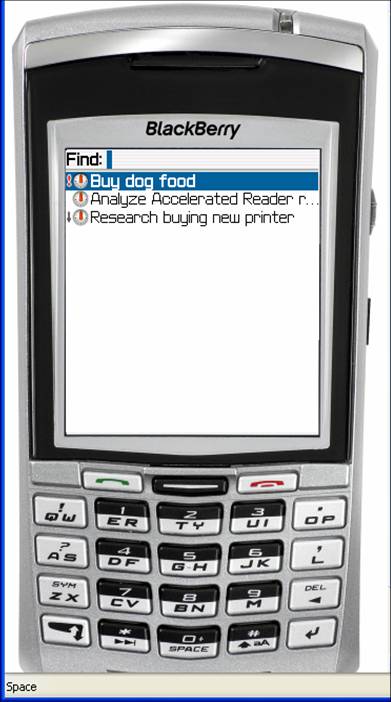
I have found the task list to be the weakest element of the BlackBerry. With a little thought, however, I have been able to make it work quite well for me. The strength I do find in the task list is its easy search capabilities.

When you go to Tasks and simply start keying in a word, you are automatically searching. With each keystroke, your list grows shorter. Finding any task on the list in a few seconds is a breeze.

Saturday, February 03, 2007

Set the calendar view to "monthly"


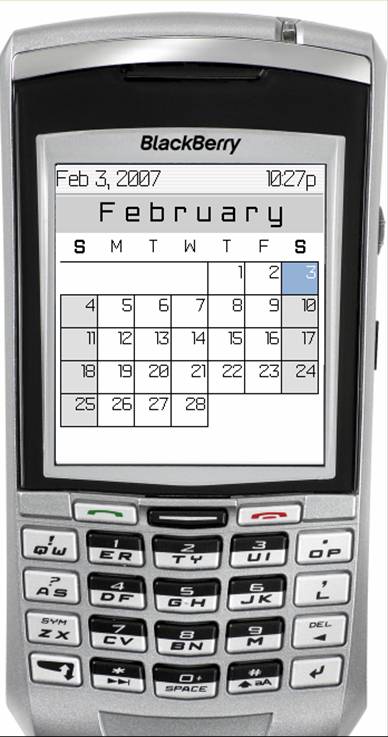
After quite a bit of experimentation, I am sold on the "monthly" view. The main reason is that I can see the "big" picture. Even though a cannot see the text of any appointment, I can get a idea of how free or packed any day or week is with a single look at the monthly calendar.

Any day which has an "all-day appointment" is going to appear in bold. A series of dots just to the left of the calendar day lets me know if I have appointments and whether any particular appointment is near the beginning, middle, or end of the day.

When I am looking at the monthly calendar, I am exactly one click away from looking at today's daily view. By default, the cursor is going to be resting on today's square of the monthly calendar. By pressing the return key, I am now looking at today's "day view."

Navigating while looking at the monthly calendar is a breeze. If I roll the track wheel back and forth, I move through the month a day at a time. Here is the neat part--If I hold the "alt" key (lower left corner) and roll the track wheel, I go forward or back a week at a time. This trick makes it easy to move from month to month.

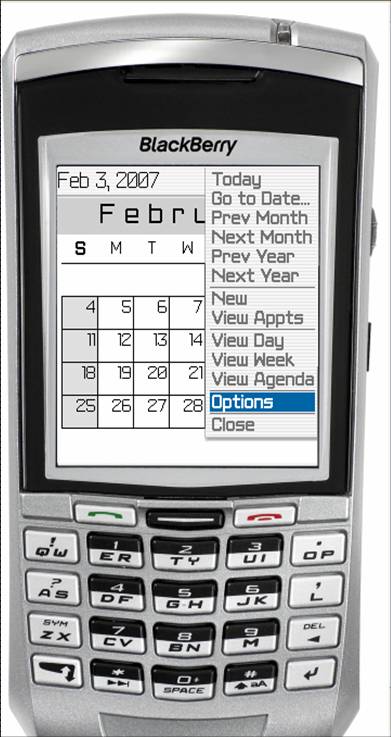
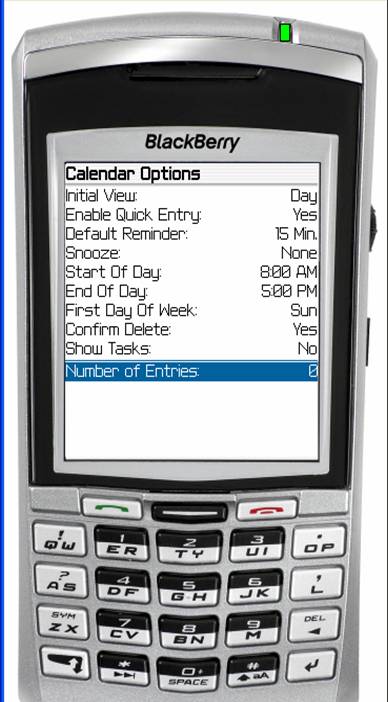
You can make the monthly calendar the default view. While you are looking at the calendar, click the trackwheel and choose "Options." For "Initial View," choose "Month."

Saturday, January 27, 2007

Calendar Tips


Go to “Options” by clicking the track wheel and scrolling down.

“Enable Quick Entry” should be set to “Yes.”

You probably want to change the “Start of Day” to an early time.

Sunday, January 21, 2007

Setting up a second profile


Set up a second profile:

  1. Set the BlackBerry to “vibrate” during for phone calls, calendar events, and direct connect.
  2. Set the BlackBerry to do nothing for e-mails.
  3. If the BlackBerry vibrates, look at it.

When you are in meetings or other places where you do not want the BlackBerry to "ring," set this one as your active profile. Your BlackBerry will vibrate when you truly need to at least look at it. E-mail will not vibrate when you are using this profile. You will be able to trust that if the BlackBerry vibrates, you truly need to look at it.

Saturday, January 20, 2007

Continuing with profiles

If the Blackberry gives the same alert for an important call and junk e-mail, you cannot trust the alert feature.

Tuesday, January 16, 2007

What’s the strategy here?


What’s the strategy here?

E-mail should be handled as a group several times a day—not every time one comes rolling in.

Tuesday, January 09, 2007

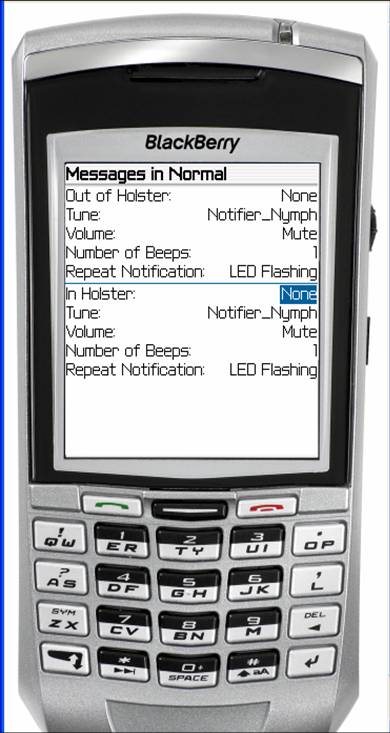
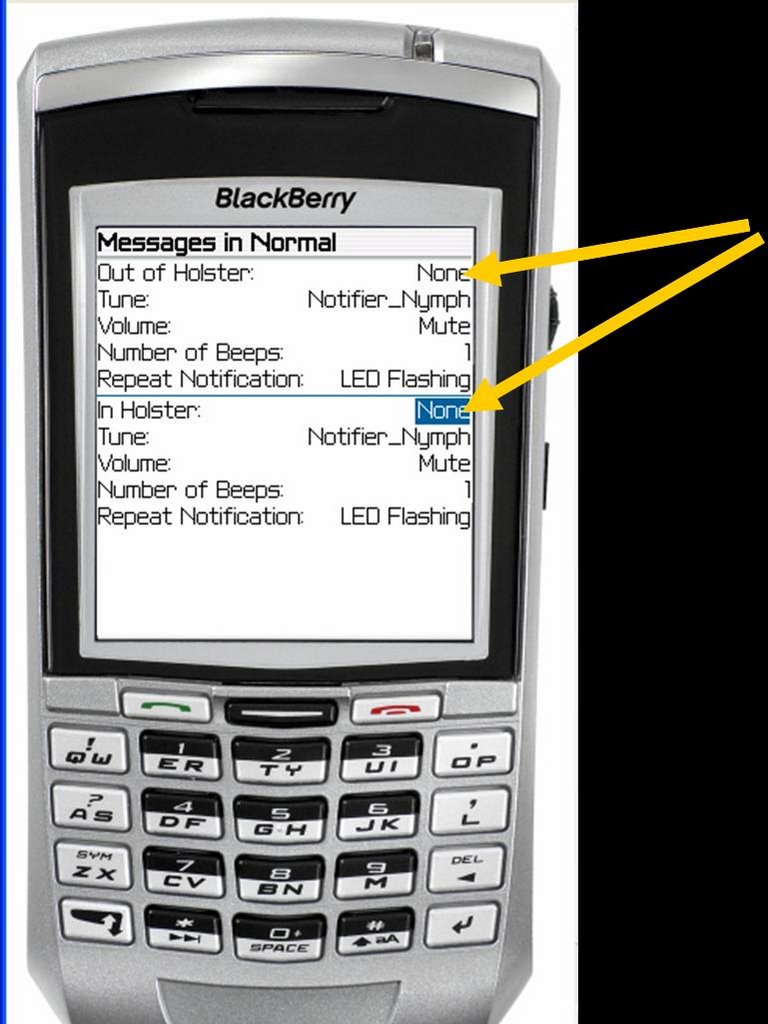
Profile Settings--Messages


“Messages” and “Level 1 Messages” will be set to “Vibrate.”

Sunday, January 07, 2007

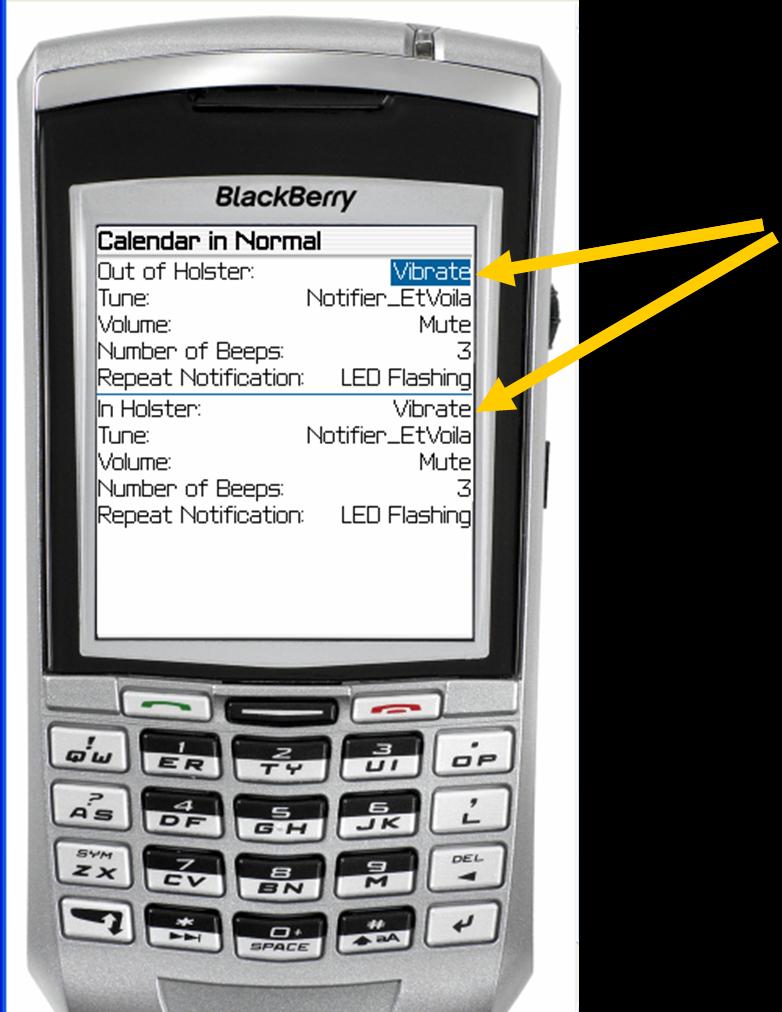
Profile Settings--The Calendar


Select “Calendar” and change the notice to “Vibrate+Tone.”
The phone and any other “real time” communications should also be set to “Vibrate+Tone.”

Saturday, December 30, 2006

Working with profiles


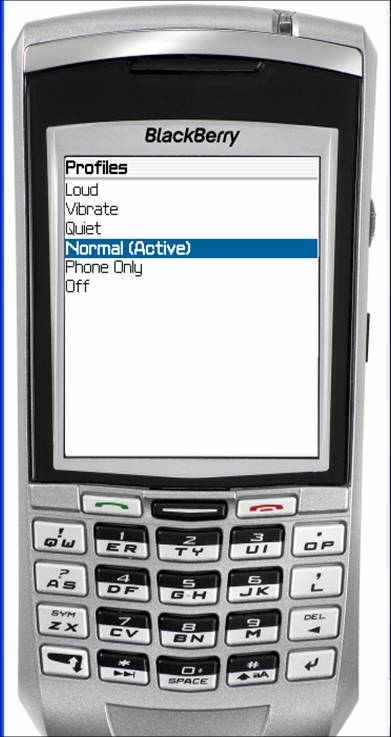
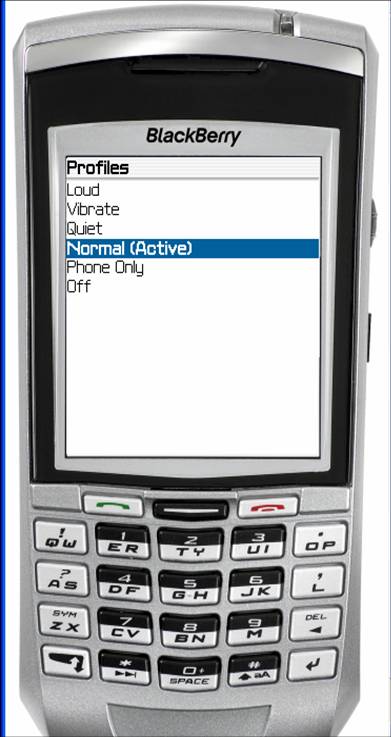
Profiles controls ringing, sounds, and vibrating for e-mails, phone calls, direct connect, and appointments.

Press the “Enter” key to open the “Active” profile.

The strategy is for the Blackberry to do the following:

Phone—Vibrate+Tone
Direct Connect—Vibrate+Tone
Appointment—Vibrate+Tone (different tone)
E-mail—Vibrate only

You can tell by the sound what is happening

Thursday, December 28, 2006

Don’t let your Blackberry cry “Wolf!”

Do you really want your BlackBerry to ring every time an e-mail rolls in?


Over the next several posts, we will look at how to set your "profile" so that you BlackBerry alerts you the way you wish.

Monday, December 25, 2006

Programming the "convenience key"

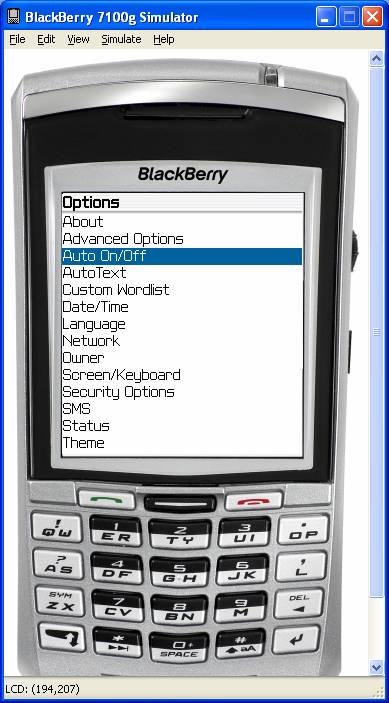
The “Convenience Key” can be programmed. I want to be able to get to my task list quickly, so I have programmed the convenience key to take me to the task list.

You do that in “Tools” or “Options.”

  1. Go to “Screen/Keyboard.”
  2. Scroll down to “Convenience Key Opens.”
  3. Press the “Space” key until it says “Tasks.”

Pressing the Convenience Key from anywhere now takes you straight to your task list.

The post below gives several screen shots from this process.

Programming the "convenience key"


Sunday, December 24, 2006

Let the BlackBerry turn itself on and off


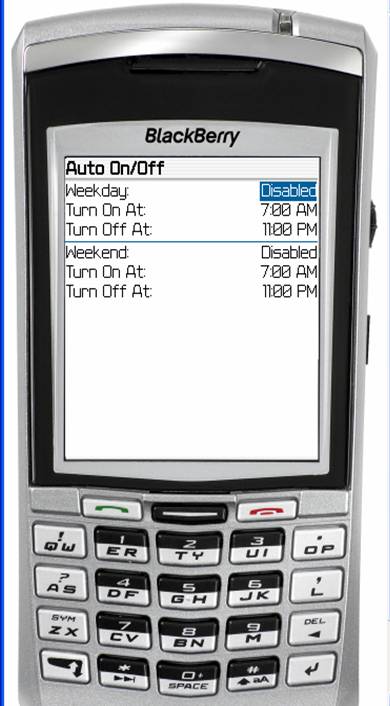
You can have the Blackberry turn itself on and off automatically. Go to "Tools" or "Options" on the home screen. Select "Auto On/Off."


Change “Disabled” to “Enabled.” Select on and off times.

Wednesday, December 20, 2006

Substitutes for the track wheel


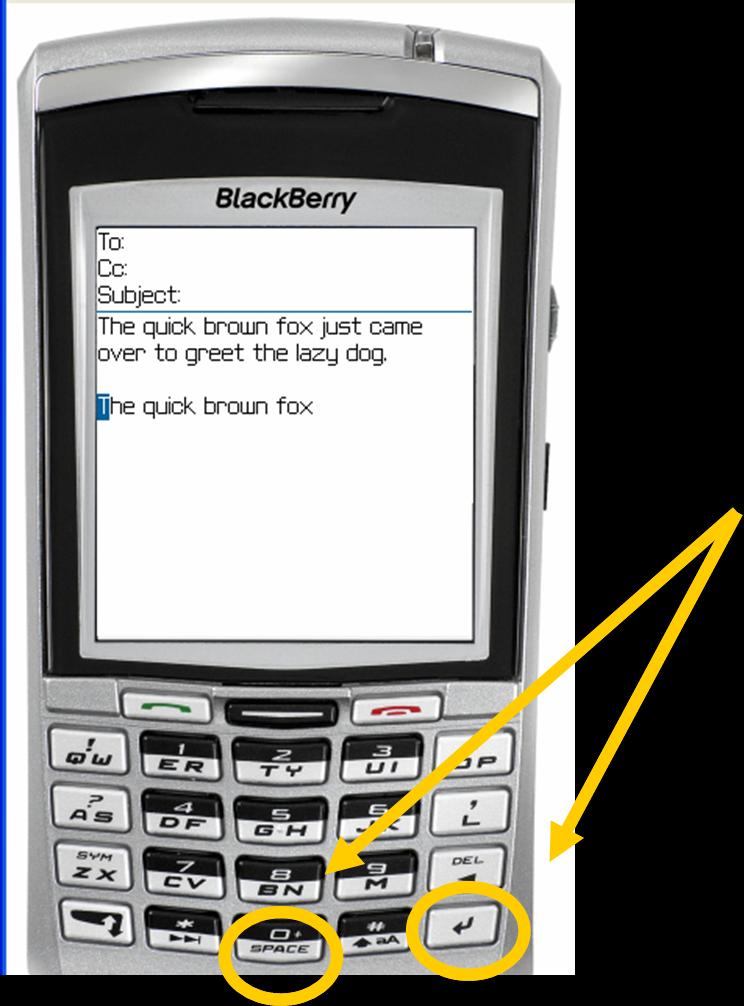
In general, try using either the “Enter” or “Space” key as a substitute for clicking the tracking wheel.

Tuesday, December 19, 2006

Other shortcuts

Holding a key for a moment will capitalize that letter.

Hitting the "Space" key twice will insert a period.

Friday, December 15, 2006

E-mail addresses

Here is a shortcut when you are composing a new e-mail and have to key the e-mail address. When you get to the spot in the e-mail address where you should insert the "@", simply hit the space bar. When you get to the spot where you would insert the dot, also hit the space bar. The blackberry will automatically format your e-mail address.

Tuesday, December 12, 2006

Troubleshooting the BlackBerry--the soft reset

I have run across a couple of problems since I started using the BlackBerry in August, and both have been fixed by the "soft reset."

One problem I was seeing was an error message that would prevent me from accessing the task list. I have not seen that problem since the first week I was using the device.

The other is a problem that not only has happened to me, but also to one of my co-workers. The BlackBerry was not making the correct sounds that the Profile was saying they should make. Instead of the phone using the ringer or sound we had selected, it either would not ring (but would only vibrate) or would use the default ring tone. Any alerts that had been attached to appointments or tasks would only vibrate even though the profile specified they would ring.

If you are seeing anything like this, the soft reset is a good first step. Simply hold down the ALT key, the CAP key, and press the DEL key. Another way to accomplish the same thing is to take the battery out and put it back in again. In either case, you do not lose any data. You will find it may take the BlackBerry several minutes to restart, so just be patient.

Monday, December 11, 2006

E-Mail best practice

Scan the e-mails on your Blackberry for urgent messages and those you can respond to quickly.

Wait and handle the bulk of your e-mail on your computer.

Now, dump all of the e-mails from your Blackberry.

Thursday, December 07, 2006

Deleting a group of messages at one time


Want to get rid of a whole bunch of messages at one time?
Hold the “Shift” key and roll the track wheel.
Now, hit the “Del” key.

Deleting messages easily


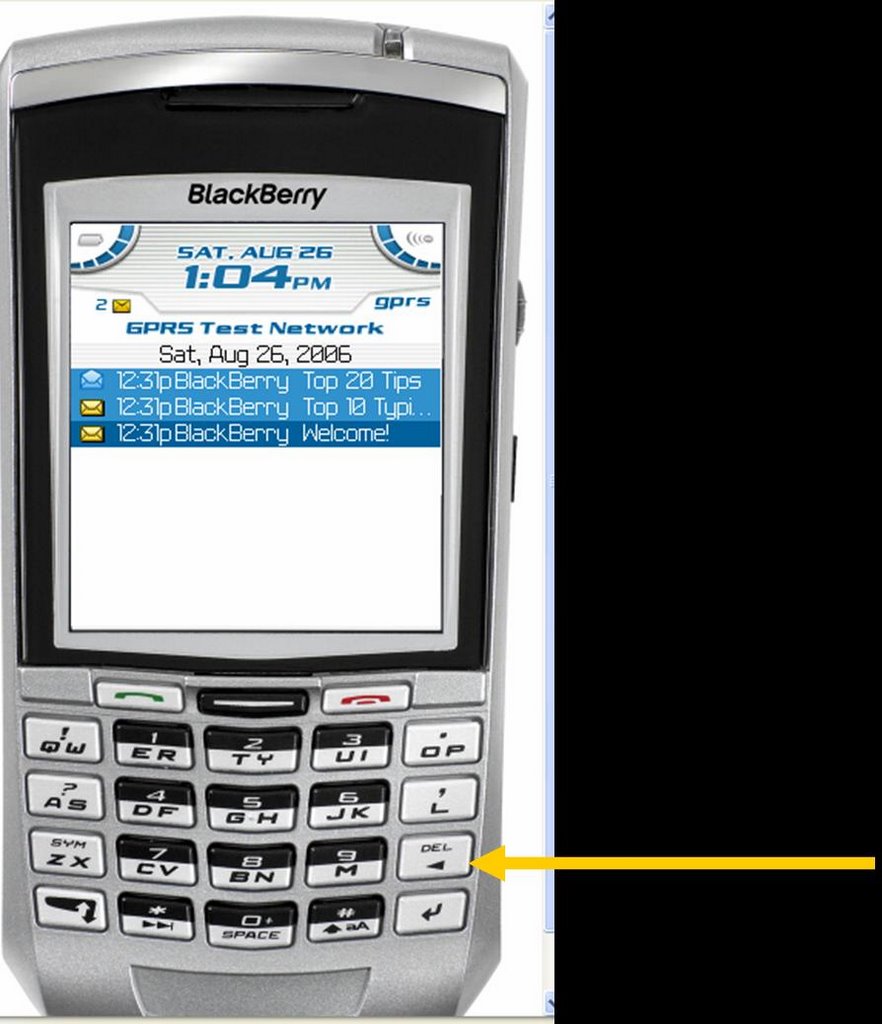
Done with the message? You can delete it by hitting the “Del” key.

There is no need to click the trackwheel and choose the delete option from there.

In fact, many of the tricks you will see here involve ways around using the trackwheel.

Sunday, November 26, 2006

E-mail--scrolling a screen at a time


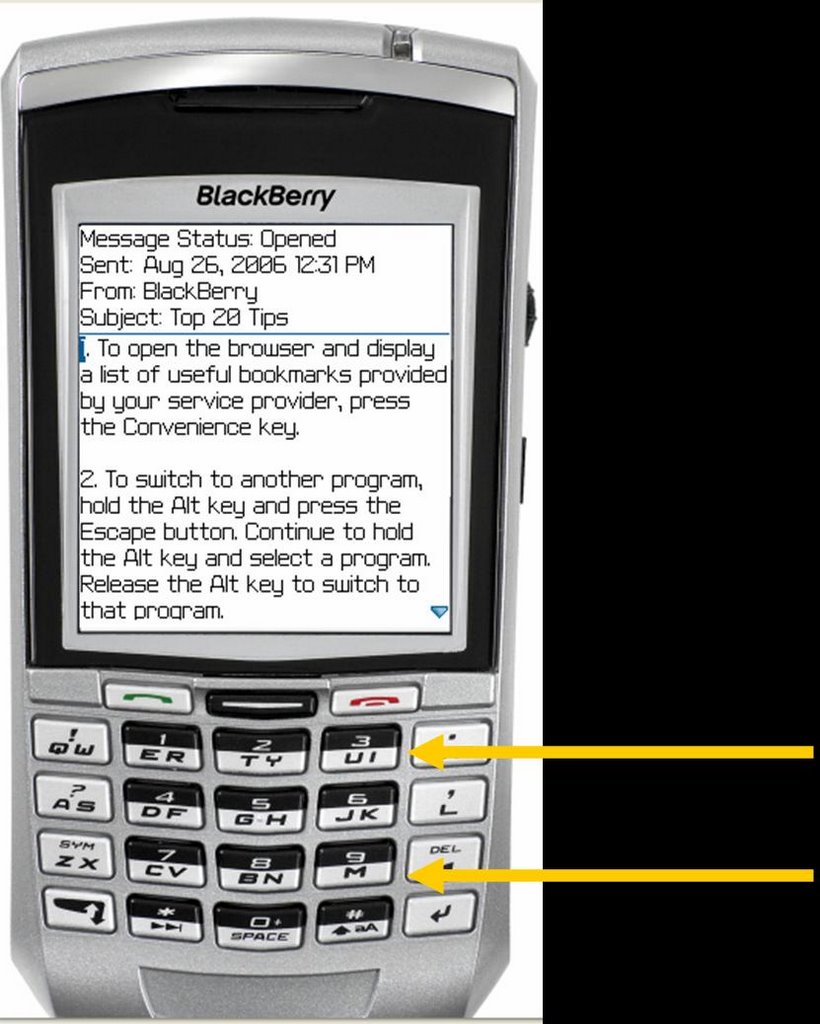
As you read the e-mail, you can scroll the track wheel OR you can hit “M” to jump down a screen or “U” to jump up a screen.

Saturday, November 25, 2006

BlackBerry Tricks and Tips--An Introduction


At the beginning of the school year, each administrator in our school system was issued a BlackBerry. I had been a Palm user for about 5 years, so I was looking forward to what I thought might be a learning curve. Yes, there are differences between how I organize with the BlackBerry versus what I did with my Palm.

Over the last several months, I have become keenly interested in 1) how many people I see on a day-to-day basis who are using a BlackBerry; 2) the growing number of questions I see posed about how to organize (especially tasks) with the BlackBerry; 3) the little I see written that specifically addresses how to use the task list effectively.

This post starts a series of outlining tricks, shortcuts, and strategy I have learned along the way. I will begin with the track wheel, or more specifically, how to get around using it. Using keyboard shortcuts instead of the track wheel eliminates many steps.

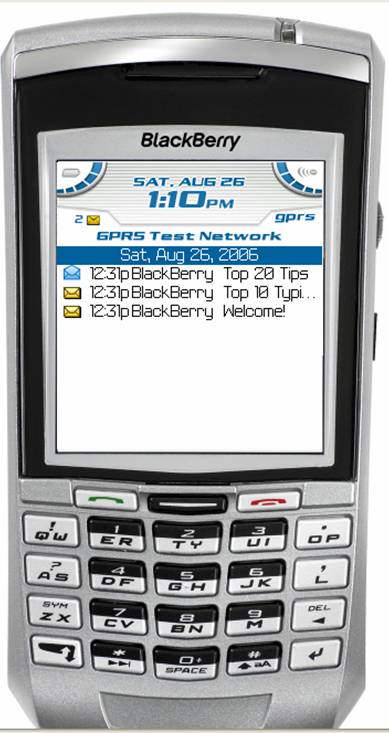
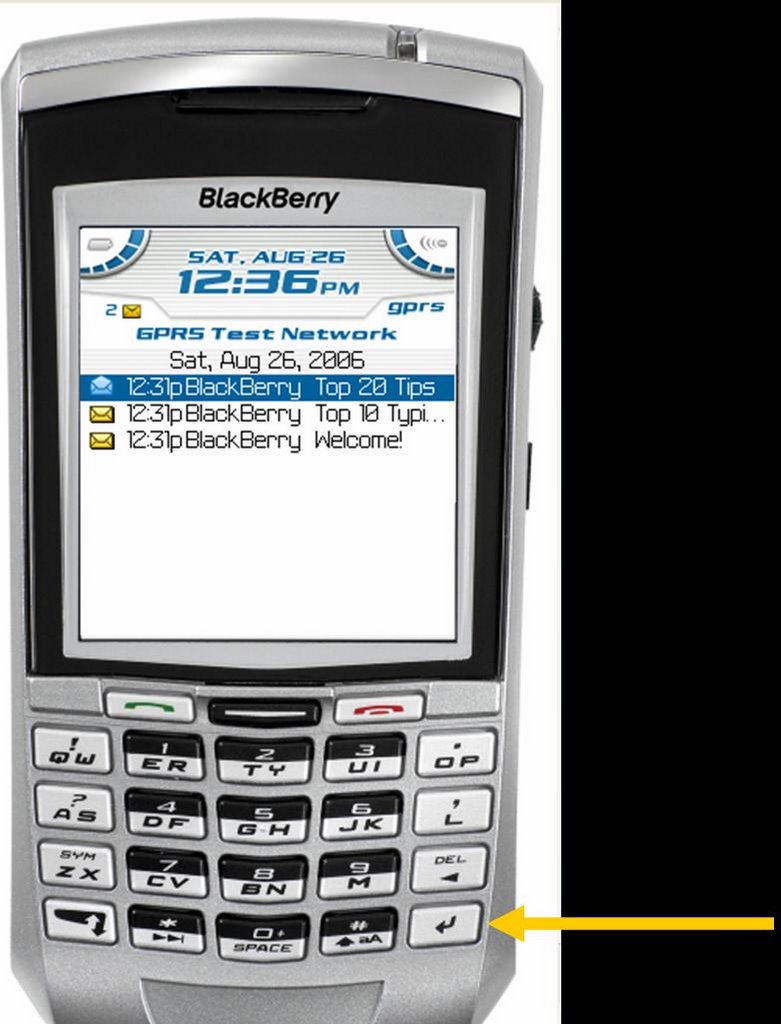
Let's start with opening an e-mail message. You could click the track wheel, scroll the wheel to "Open," and click the wheel. An easier way is to simply hit the “Enter” key
.

Tuesday, November 21, 2006

Translating your blog

People often ask me how I am able to have my blog translated into the various languages just by clicking a link. The process is surprisingly easy:
  1. Go to Google.
  2. Click on the small link that says "Language Tools."
  3. Scroll down the page until you see a heading that says "Translate a web page."
  4. In the box, enter the URL for the page you wish to translate.
  5. Just below the box, select the language to translate from and to and click on "Translate."
  6. You will be taken to your page, and you will be viewing that page in the new language.
  7. Look at the URL at the top of that page. That is the URL for that page in that language.
  8. Highlight and copy that URL.
  9. Create a link and paste that URL as the address for that link.

Saturday, November 18, 2006

What good is a blog? Yet another answer

I have previously written about two blogs that I created for our school system. Little by little, we are seeing the benefits of this form of communication. This past Wednesday provided an excellent example of how a blog can be the quickest and most effective way to communicate a detailed message to a large body of people.

Early into the school day, weather reports were indicating severe weather for the early afternoon, and the decision was made that we would dismiss school at mid-day. Surrounding schools systems were doing the same. As usual, we called radio and TV stations. At best, however, we could only count of them to announce an abbreviated message. Because of our bus routes, our elementary schools, junior high, and high school would dismiss at three different times. Asking the media to announce three different dismissal times was asking too much. As you can imagine, phones were ringing off the hook at each school and the central office asking if we were going to dismiss and at what time.

Within two minutes of word getting to me that we were closing, the complete announce was on our school system blog. Any parent who thought to check our blog got the information, got it completely and accurately, and got it before any radio or TV station had the information.

What good is blog? We just found one more answer.

Monday, October 16, 2006

How do I keep up with the blogs I like?

Often, one must experience the problem before appreciating the solution. As we look find blogs that we want to visit often, we will invariably find we need some efficient way to manage them. How do we know when new posts have been added? Where can we keep up with the URL for each one?

RSS
The answer is something called “Really Simple Syndication” (“RRS” for short). How simple is it? When I find a blog I like, I “subscribe” to it. From that point on, any time there is a new post in that blog, the post appears as simply another e-mail message. The act of checking my e-mail also checks every one of those blogs for new posts.

How do I get started?
You will need an “RSS reader.” The one I use is called intraVnews. It is free for personal use, charities, and non-profit organizations. You can download it from here.

The system requirements are:
  • Microsoft .Net Framework 1.1. (Click the link to download it)
  • Operating Systems: Microsoft© Windows© 98 SE or higher.
  • Microsoft© Outlook© versions: 2002/XP (10.0), 2003 (11.0).

Tuesday, October 03, 2006

What's not working? What would it take to fix it?

Conveniences are all around us. From microwave ovens to electric pencil sharpeners, we have an abundance of tools that make our lives easier—provided they work. What a handy tool we have in that electric stapler—only it doesn’t work because it’s out of staples. How about that empty tape dispenser in your desk drawer?

This week, I challenge you to look at what’s not working in your world and do something about it. The electric stapler sits unused because it’s out of staples and you haven’t refilled it because you are out of (or can’t find) more. You have been meaning to order more but you keep forgetting. The next time you think about needing staples is—you guessed it—when you go to use that stapler and find it’s still empty.

As you come across these little annoyances, take a second to decide what needs to be done to fix it, and jot it in your planner. Don’t put getting staples on the list for today. Instead pick a day about a week out and start a list of little items to get. A week from now, you can handle that whole list at once.

Fixing the problem is the first step. The second step is deciding how to avoid the problem in the future. Think about this one—at your house, when do you decide you need to buy toothpaste? Is it when the tube runs out and you realize there are no more under the counter? Or, is it when you take the last one from under the counter. In the first case, you have a minor crisis—you need toothpaste NOW. In the second case, you just need to put toothpaste on the grocery list and go on about your business.

Ask yourself the same thing about supplies in your classroom. Do you order more when you are OUT or when your reserve is low? What about textbooks? If a new student enrolled tomorrow, would you have books for him? If not, why not go ahead and put in a request now, so that when you DO get another student—and you will—that you are prepared. You own 7 umbrellas, yet you never seem to have one in the car you when a downpour occurs. What could you do to fix that problem once and for all?

What else in your classroom doesn’t work? What about that regular pencil sharpener where the handle has been loose for 2 years? What would it take to fix that? You have two desks that are awfully wobbly. What would it take to fix them? Realize this is a thought process that seldom occurs to most people. Too many of us simply get so used to all of the things in our lives that don’t quite work that we soon stop thinking about them anymore.

Have you cleaned out your desk lately? If not, put it on your to-do list. Out go the pencils with no points, the dried-up ink pens, the empty packs of Sweet & Low, and a host of papers that never should have been there to start with. You will be amazed at what you find there that you had no idea you had.

Why do people resist thinking through what it takes to fix the little broken things? I think the answer lies in that thinking through what needs to be done creates a long to-do list for people who already have too much to do and try to keep up with all of it in their heads. For those of us who have a “capture tool,” life is easier. We take a second to jot down what needs to happen. We organize our list in a way that groups similar items together. Then, we handle that whole batch all in one sitting.

Get all of those conveniences in your life working and watch some of the stress in your life go away.

Tuesday, September 05, 2006

New ideas, update on office


The past month has been a busy month, but a very productive one. We are well on our way to getting two blogs established to improve communication in our school system.


TalladegaCitySchools.blogspot.com is a tool to communicate with parents and the community while TeachTalladega.blogspot.com is designed to allow our central office and each school to communicate with everyone else in the school system.

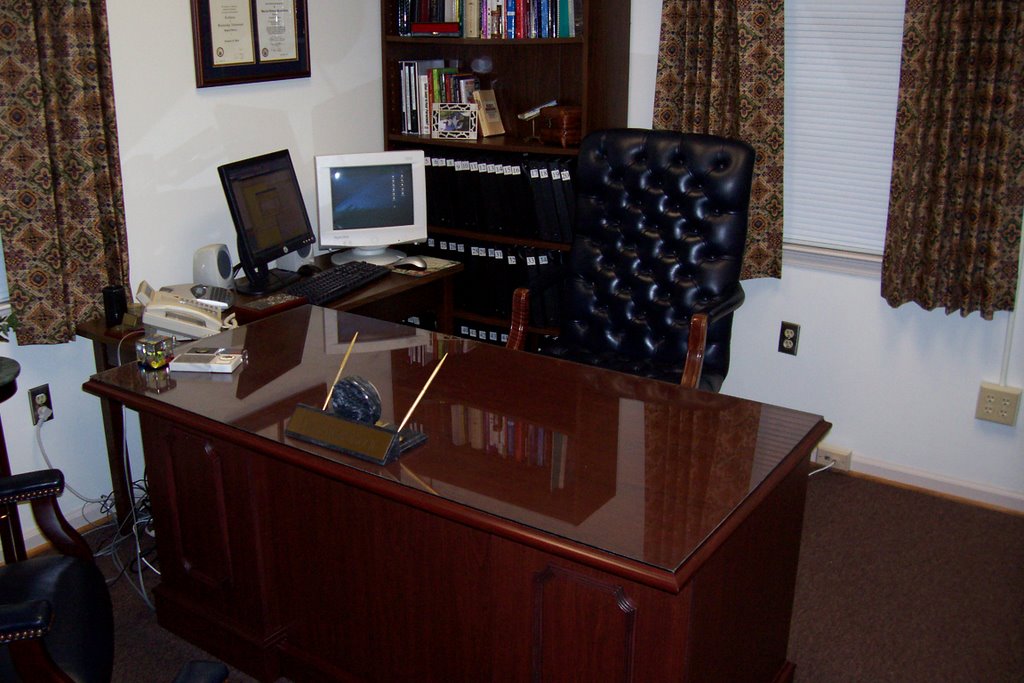
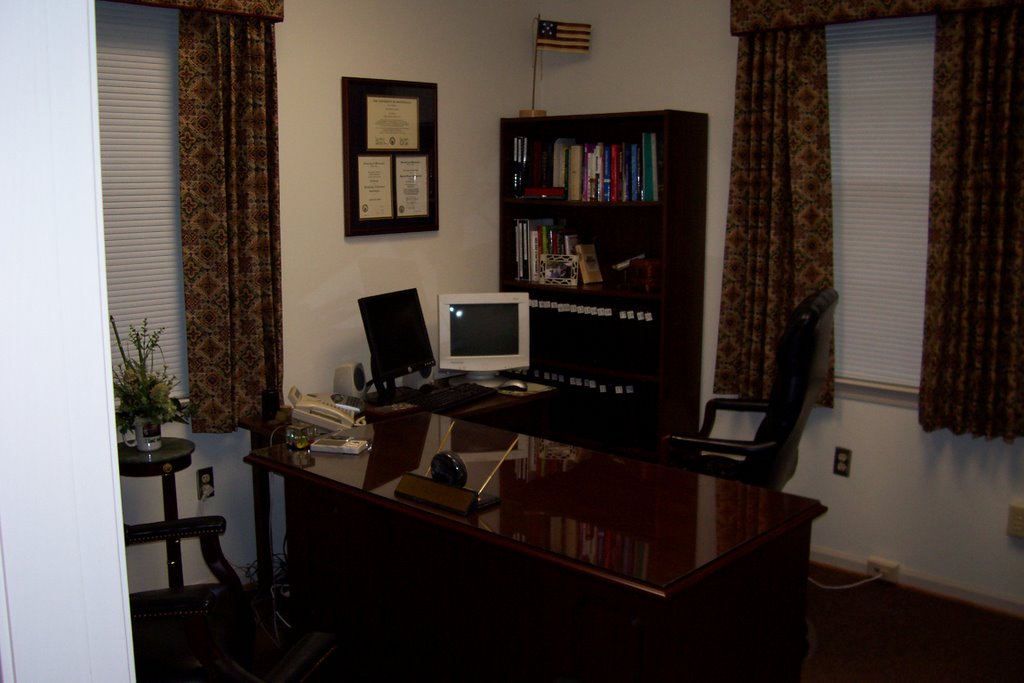
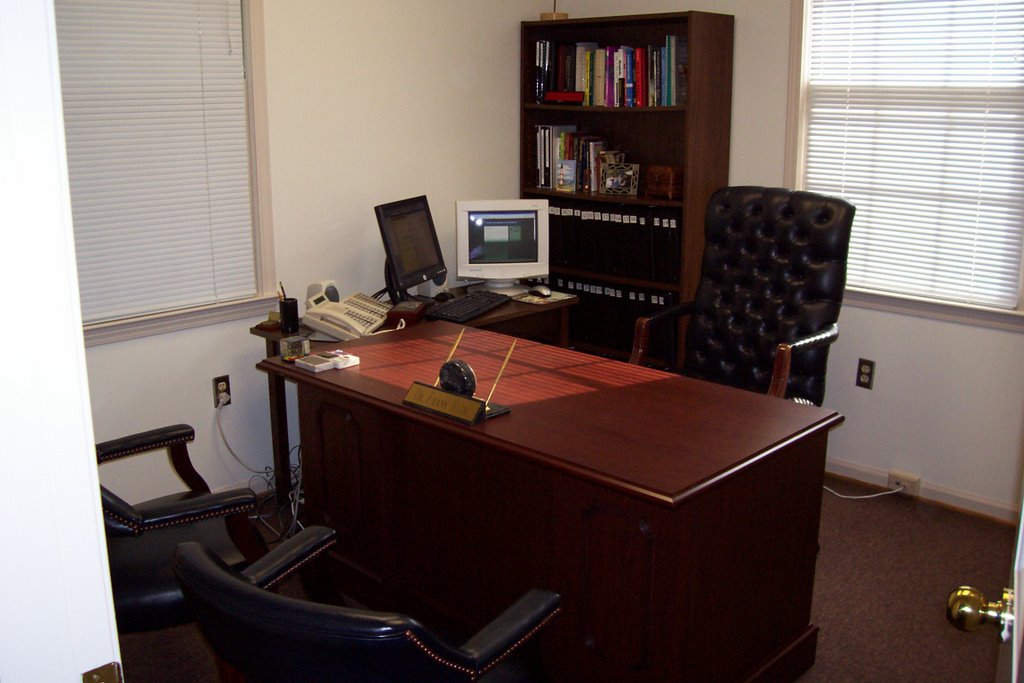
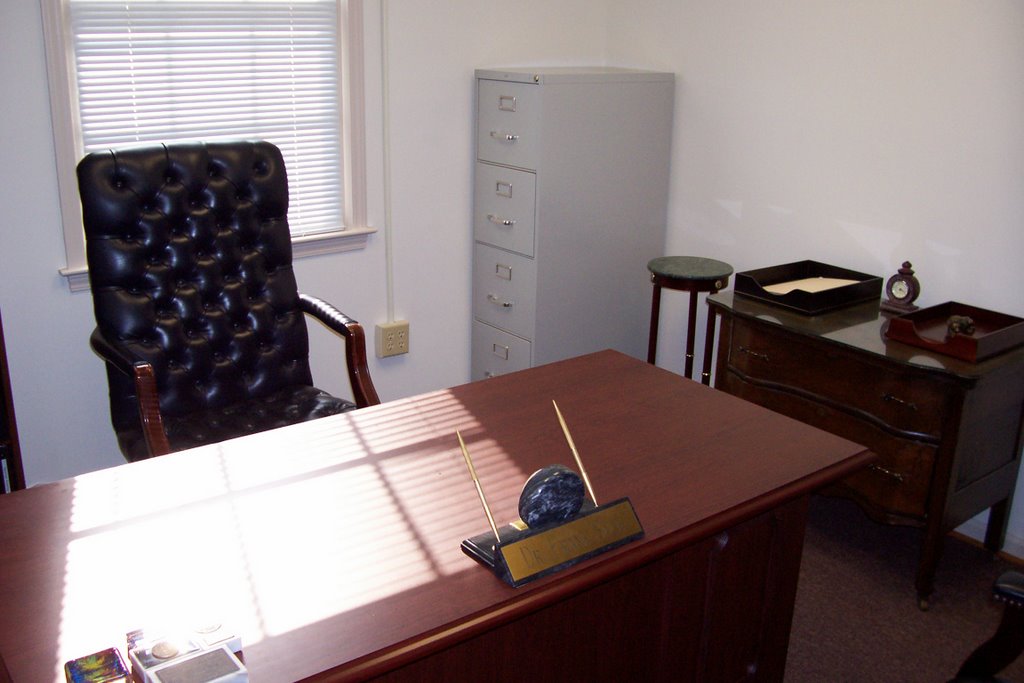
Earlier, I had posted pictures of my new office. Here a few pictures now that curtains have been hung and pictures and plaques hung on the wall.

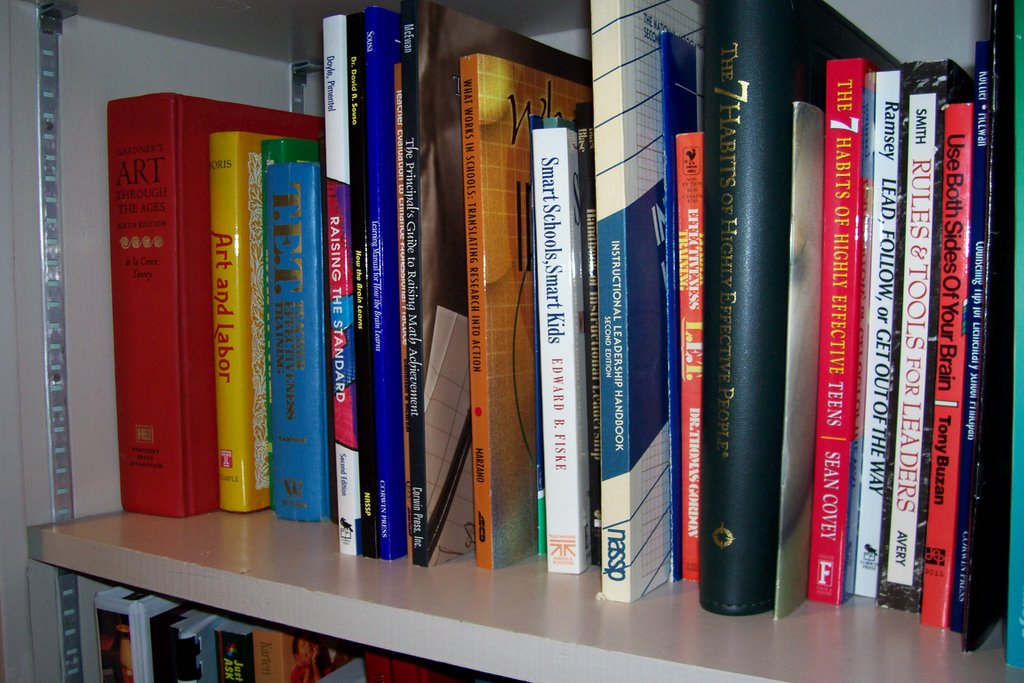
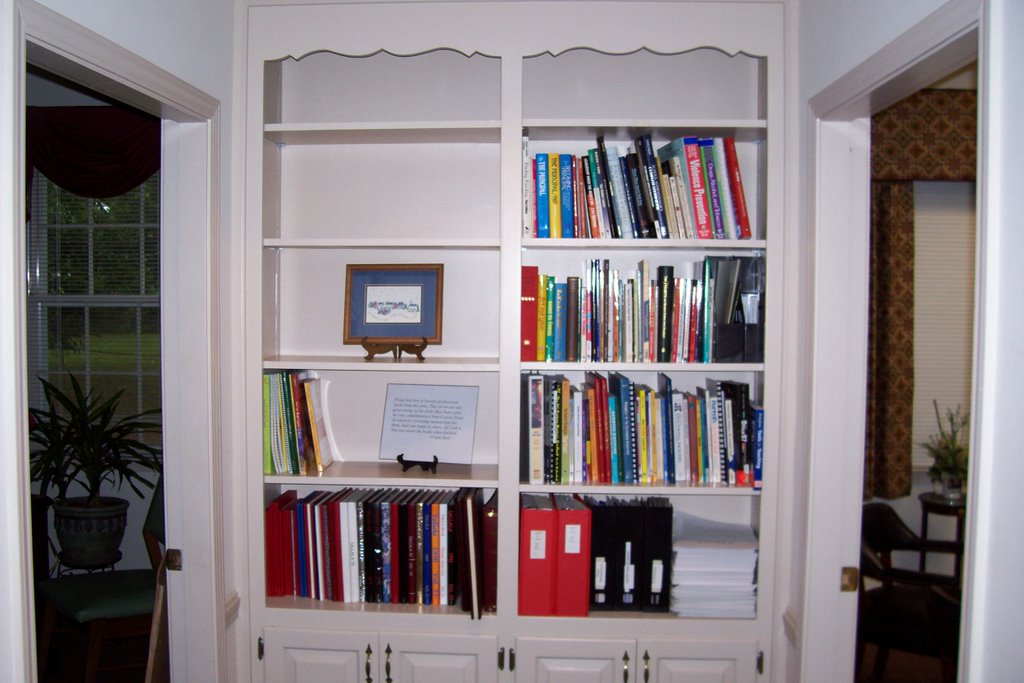
Also, I am using a bookcase just outside my office as a lending library.


Thursday, July 20, 2006

You never know what today's mail may bring...

Going through today's mail, I opened an envelope containing a complimentary copy of "Pro Principal," a newsletter for school principals. The "cover story" was a feature our use of blogs at Graham Elementary School!

Amy Shannon, the editor for the publication had contacted me some time ago after having read my article in Principal magazine. I was quite surprised to see the article, especially displayed so prominently and with such coverage of our school.

My thanks to Shannon for spotlighting our school system.

Wednesday, July 19, 2006

What if your hard drive crashed today?

If your computer's hard drive crashed today would it mean:

An inconvenience? You would simply load your backup onto another computer and continue to do use your documents. A new hard drive would be purchased, the operating system and programs reinstalled from the CD-ROMS and then your documents re-loaded; or

A catastrophe? All of your documents have been lost forever because even though you know you should do a backup, for one reason or another it just hasn't happened.

If the answer is the later, whether you realize it or not, it impacts the way you work with a computer every day. As long as lack a system for backing up, you cannot trust your computer. You unconsciously avoid getting too attached to anything stored on it, because you realize it could all be gone in an instant.

In reality, data is much safer now than ever before. A decade ago, a fire, flood, or tornado could destroy every record in a school with no hope of retrieval. Today, even though a natural disaster could destroy the contents of an entire building, the data stored on a backup off site is safe.

The content of the "My Documents" folder at school are backed up, and that backup is at my house. Likewise, I have backed up the "My Documents" folder on my home computer. That backup lives at school.

Being able to trust that I am not going to lose digital data gives me the peace of mind which keeps me from feeling the need to print everything. Digital data is much faster that finding paper even in a good paper filing system.

Sunday, July 16, 2006

Two new blogs

A year ago, I established two blogs. One was designed to communicate with teachers and staff in the school where I served as principals. The other was designed to communicate with parents. How easy it was to write a quick post and have it available for the reader in minutes! No Xeroxing, no stuffing paper into mailboxes, and a complete history of all of my posts neatly archived. Who could ask for more?

As I move from my school to the central office, I have already begun to suffer from withdrawal! How will I be able to communicate with teachers throughout the school system? How can I get our message out to parents and community members?

I guess the answer now is the same as it was a year ago--a blog (or two). This evening, TeachTalladega.blogspot.com and TalladegaCitySchools.blogspot.com were born! The biggest difference between these two blogs and the ones I have created in the past is that I am inviting others to become members of these blogs. Central office personnel and principals seem to be the most logical choices. I figure that with all 7 schools posting to these two blogs, there will always be fresh content and people will continue to visit the blogs.

Saturday, July 08, 2006

Two monitors


I have been seeing a great deal lately about the effects on productivity of having two monitors, so we are starting the new job with that setup. In this shot, I have Outlook on one monitor and my web browser on the other.

One example of how this setup is wonderful came Thursday. I was putting together a PowerPoint presentation which consisted of screenshots from the Internet. Normally, this task would have entailed maximizing the browser, hitting “Print Screen,” minimizing the browser, pasting the item in the PowerPoint, and then continuing that process until complete.

With two monitors, I simply open the browser on one and PowerPoint on the other. As I move the mouse, it travels from one screen to the other.

In the pencil/paper world, we often lay two pieces of paper side-by-side. Often, we are referring to one while we write on the other. At other times, we are comparing the two. We would never dream of putting one paper on top of the other and exchanging their tow positions countless times. However, that’s exactly what we have been doing with our computers for a couple of decades. With two monitors, my digital world has caught up with a good idea from our paper world.

Bulk storage


What in the world is this? Is this the most recent version of these policies? Do I really need to keep this?

The job I am starting is the 5th position I have held in schools since beginning my career in 1982. In each case, I found myself asking these kinds of questions about material I would run across. I have found that time answers those questions. The best route is to put it away, and then look at it again some weeks or even months later. By that time, the answers are usually obvious.

“Bulk storage” is a great answer. In my last position, as principal of Graham School, one shelf in a closet served as my bulk storage. Anything to be handled in the future that was too bulky for the tickler files went there. A repeating tasks on my list would remind me to examine that shelf and take action on what I could.

In the new office, that two-door cabinet in the center has been nominated for the task of bulk storage. As I have come across notebooks, etc. for which I had questions, I made the appropriate entry on my to-do list, and added to the physical item to the bulk storage cabinet. The plan is not to even look in that cabinet for several weeks. By that time, I will have worked through my list, asked the proper the people the proper questions. When I do open that cabinet again, the value of each item and where it needs to go should be much more obvious.

More on moving an office


June 6

The last of the bits of painting were completed towards the end of the day. I could now move in one filing and get boxes of file off of the floor.

June 7

The goal for today was to get the office in its final form with the exception of window treatments and diplomas/plaques on the walls. I also had quite a stack of papers that had accumulated during the week.

Here are a couple of shots of the office as it looked at the end of the day. The to-do is plenty long, but the papers are out of site. I want work from my list, not a stack of papers. Part of today was looking at each paper, making decision about what needed to be done, putting the actions in my list, and including in the list where to go to put my hands on the paper.

Along the course of the day, I made stacks of materials to deliver to other schools. I had come across many individual sample books for 1st and 2nd grade. I delivered those to one elementary school so they could be passed on to a teacher for her classroom library. Several thick notebooks which pertained to the high school were delivered there. I even unearthed a copy of the high school’s SACS review from 1968!

I came across multiple copies of materials that were doing nobody any good sitting at the central office. One was a wonderful handout on troubleshooting a computer. I put the copies in the mailboxes of each school.

The pictures show the finished product. Still to be done are getting curtains for the windows and hanging things on walls.

Thursday, July 06, 2006

Moving an office

At one time or another, most all of us move—either from one home to another, one classrooms to another, or one office to another. My major project right is a job change. After nine years as a principal, I have moved to a central office position with the same school system. The change in position entails moving from one office to another. I thought others might be interested in how I handled, and am still handling) the process.

July 1
This was the first official day of my contract. Even though it fell on Saturday, Davonia (my wife) and I were at the new office. The first item of business was to clear everything out of the office and paint the 10x10 office. One challenge was that one entire wall was lined with filing cabinets, so during Day 1, everything was painted except the two walls blocked by filing cabinets.

Lots of stuff went straight to the dumpster and lots of other stuff went into books for me to go through as time permits.

July 2
We moved all of the boxes from the old office to the new one. The two buildings are only a block apart, so we were able to make the move by loading boxes in the car and making several trips. We did move one piece of furniture—a bookcase, which I simply put on a set of hand trucks and rolled down the street. We were able to unbox books and get them directly on shelves.

One thing that made the move easier was to go thought everything in the old office and do the cleaning out on that end. Taking the time to perform the task on the front end meant that I was not moving junk from one place to another.

July 3
The focus for today was two-fold. First was the task of ridding the office of the filing cabinets that were eating up a full 20% of the floor space. The second task involved the computer—getting one set up in the new office and clearing things off of the one I was leaving behind.

The morning was spent unloading, filing cabinets in two areas (a total of 10 filing cabinets), moving the 5 newly-emptied filing from my office to an off-site location, and finally loading the files—5 filing cabinets worth off-site and another 5 filing cabinets worth in another area within our central office.

The computer was a challenge simply because much of the information on it is information the new principal will need. At the same time, I did not want to leave behind memos I had written, a myriad of Outlook tasks and appointments from the past, and access to e-mails from the past.

The process consisted of burning files to several CD-ROMs. Backing up “My Documents” took care of the majority of what needed to be copied. I also burned to a CD-ROM by Outlook .pst file and Outlook archive files and well as the bookmarks from Foxfire.

The next step was to go to the new computer and import my pst file into Outlook. That process went off without a hitch. Of course, that process only brought in the data. Doing all of the setup to get Outlook to look the way I want, archive what and when I want, etc. was something I had to do. Once all was right with Outlook, I synced my Palm and held my breath. It worked! The initial setting I used was for the desktop to overwrite the Palm.

With Outlook safely in place, I returned to the computer in the old office and began the process of deleting files the new principal would not need. A great deal of time was spent going through Outlook to delete appointments, tasks, and contacts that would be of no benefit to my successor. I have many repeating tasks set up in Outlook, and all that are relevant are still there for the new principal. The work I left unfinished is there, along with a complete calendar for the coming year.

Did I mention my new computer is set up with two monitors? In the last few months, I have read in countless sources about the value of two monitors. Right now, I have Outlook on one monitor while I compose this post on the other.

July 5
After taking off July 4, today was the first real day on the job. I got to the office at 6:30 and began going through and throwing away. A pair of meetings encompassed most of the morning and early afternoon.

A new desk arrived mid-morning, and being able to load it got several boxes off of the floor.

That evening, Davonia came up and the final two walls received a much-needed coat of paint.

July 6
Today, I am beginning to see really being able to get back to work on projects. I loaded all of the “My Documents” files onto the new computer. I downloaded and installed Firefox, SpyBot, and SpyBlaster. All of the Firefox bookmarks imported easily.

Where do we go from here?
The one big question mark is the phone system. Several people at the central office have changed locations within the building, but phones have not been rerouted. I am getting calls for the person who was in this office before me. As a quick fix, I am going to change the voice mail message to tell people how to call the person who has just vacated this office, and invite anyone who was really trying to reach me to leave a message.

I still have several boxes to go through. My plan is to spread it all out and determine:
Where is there duplication? (Duplicates get throw out)
Can I find this same thing in digital form? (If so, the hard copy gets thrown out.)
What stuff do I simply not know what to do with. I had found from the four previous jobs I have held that if I just put it away for a couple of months, when I look at it again, I will almost certainly know what should be done with it.

Tuesday, July 04, 2006

More on Blog Settings

When you create your blog, you have a number of options under the "Settings" tab. Here are a few suggestions regarding the choices available to you:
  • "Basic" link- Answer "Yes" to every choice.
  • "Publishing" link- One way to help other people find your log is to check "Yes" to "Notify weblogs.com"
  • "Comments" link:
  1. Who can comment?-Select "Anyone"
  2. Comments Default for Posts?- Select "New posts have comments"
  3. Back links- I have selected "Hide"
  4. Show word verification for comments?- Selecting "Yes" keeps spam from being posted to your comments
  5. Enable comment verification?- Selecting "Yes" sends comments to your e-mail for your approval. This feature prevents inappropriate material from being included in comments.
  • "Archive" link- "Monthly" is a good choice. Answer "Yes" to "Enable post pages."

In the July 2005 issue of PC Today, Vince Cogley gives several suggestions for increasing traffic in your site:

  • Answer "Yes" to "Enable post pages." and also enable your site feed. Enabling the site feed will allow others to "subscribe" to your blog.
  • Answer "Yes" to "Notify weblogs.com"
  • Add your blog to Google's index by going to www.google.com/addurl.html

Thursday, June 29, 2006

Handling Blog Comments & Removing the Blogger Navigation Bar, Icon

If you attended "Your Own Blog in 10 Minutes or Less, " please go the November 2005 link in the archives and read the posts from November 16 and November 20. You will see a review of my suggestions for handling comments. You will also see instructions for how to remove the Blogger Navigation Bar and Blogger Icon. This way, students will not be able to click on the "Next Blog" link and possibly see objectionable material.

Handout from PDA Productivity

I had a terrific in today's sessions. If you attended the "PDA Productivity" and did not get the handout beamed to you, I am posting it here.

The next post I do will be a more on handling multiple projects using your Palm, so please check back.

************************************
PDA Productivity: Getting More Done and Making It Look Easy

Dr. Frank Buck

***This outline is presented as very simple text—no bullets, italics, bold faced-print, etc. The intention is that as you view this online, you will simply “select all” and electronically copy this entire outline. Then go to your Palm desktop or Outlook (whichever you use), create a new task (called something like “Set up my Palm”) and paste this outline into the note section of that task. Feel free to e-mail or beam this outline to a friend who has a Palm but isn’t quite sure how to use it as the productivity tool it could be.

-Frank Buck


Categories for Task List:

Building

Calls

Delegated

Errands

Home

Office

Unfiled (Syncs to “None” on Outlook)

*******************

Goals

I have achieved my goal when WHAT is true?

What’s the next step

***************

Next step+Goal statement

Other steps and information related to the project are the in the note section.

*************

Backing-Up Outlook

Your data is kept in a “.pst” file

Backing up on Outlook 97:

Right-click on “Outlook Today”

Choose “properties”

Click “Advanced”

You will see the path to your data

Close Outlook

Copy that .pst file and save it as your backup

Backing up on Outlook 2003

In Outlook, under the File menu, select “Backup”

Click on Options and make you selections

Browse for a pathname and choose “My Documents” as the place where you want the backup to go

Maintain the data by running scanpst every month

***************

What place does paper have? (3 phases of workflow)

Collect-May be best to do on paper until you get really good with the Palm

Process and organize-Do on the Palm

Do the work


Collecting on the Palm (Meeting notes)

Press task button

Enter name of meeting and due date

Create a note

Turn off

During meeting, turn on & off with power button

******************

Palm To-Do Preferences

Sort by Category, Due Date

Uncheck “Show Completed Items” (As you check off things, they disappear.)

Check “Show Due Dates”

Check “Record Completion Date” (Gives you a record of when you really completed things)

Uncheck “Show Priorities”

Check “Show Categories”

******************

Outlook-Getting categories to synch that first time:

Launch “Chapura Settings.”

Click the “Settings” button.

Double-Click “Outlook Calendar” (for example).

In the Chapura dialog box that pops up, click “Categories/Folders.”

Select “Handheld category = Outlook’s ‘Categories’ field.”

Wednesday, June 28, 2006

Thanks for coming to "It's About Time for Technology"

Thanks to everyone who came to this afternoon's workshop! I hope you took from the workshop ideas you can use immediately, whether it be organizing your files, backing-up your computer, or expanding the ways you are using Google.

I want today’s experience to more than a “one-shot workshop” for you, and my thinking is that this blog is going to be the best way keep the material fresh and be able to go into more detail than the one hour this afternoon allowed.

If visiting this blog is your introduction to blogging, welcome to what has become a very popular (and easy) way for people to communicate their thoughts with the “world out there.” Tomorrow, I will be doing a workshop on blogging. The idea is that you will leave that workshop knowing how to set up your own blog.

If you have questions about topics from today, please feel free to post a comment and I will be glad to go into more detail. Also, if there are other topics you will like for me to cover in this space, please let me know.

I have been writing posts related to organization and time management for almost two years, so you will find a great deal of material as you browse the previous months. I hope you will take some time over the coming weeks to look over those posts and enjoy new posts as time goes on.

Please check back often!


"Don't say you don't have enough time. You have exactly the same number of hours per day that were given to Helen Keller, Pasteur, Michelangelo, Mother Teresa, Leonardo da Vinci, Thomas Jefferson, and Albert Einstein."
-- H. Jackson Brown

Tuesday, June 20, 2006

Workshops for AETC June 28-29

I will be presenting 4 workshops at the Alabama Educational Technology Conference next week in Birmingham. Workshops, times, and locations are as follows:

June 28 3:30
It’s About Time for Technology (East Hall Room K/L)
This workshop explores organizing your computer, a simple way to back up documents, using e-mail effectively, and numerous time-management techniques which involve using the computer.

June 29 12:30
Your Own Blog in 10 Minutes or Less (East Hall Room A/B/C)
I will create a blog from scratch so that participants will be able to go home and do the same. Participants will see examples of the blogs I have created this one, GrahamSchool.blogspot.com, and GrahamStaff.blogspot.com). Finally, I will talk about issues such as how to handle comments and how to keep people who view your blog from being one click away from seeing inappropriate material.

June 29 1:45
Paper or Palm (East Hall Room A/B/C)
This workshop is designed for the person thinking about using a digital organizer or who has limited experience. We look at the basic features of the Palm, examine the Palm Desktop and Outlook, and give some basic strategies for organizing your life.

June 29 3:00
PDA Productivity
(East Hall Room A/B/C)
Want to get more done and make it look easy? This workshop is designed for the person who has a Palm (or other handheld organizer). In fact, the handout for this workshop exists only digitally. I beam the handout to the first arrivals. They, in turn, beam it to others who enter the room. We explore strategies for using the Palm as a powerful tool to organize your life.

Wednesday, May 31, 2006

School Administrator Magazine Article

This article appeared in School Administrator magazine over a year ago. I did not know that the article also existed in cyberspace until today. The thrust is a discussion of using portfolios as a portion of the principal's evaluation.

Managing School the Easy Way

Experienced teachers will tell us that school success and intelligence do not always go hand-in-hand. Often, very bright young people don’t remember to do assignments, lose their work, and spend inordinate amounts of time frantically looking for things in a messy desk.
At the same time, other students breeze through school. They seem to make school look easy, but not because they are necessarily smarter than their peers. They have acquired some very easy, very teachable habits. Here are some ideas to make our students days in school a little easier:

  • Write down the things you have to do as soon as they occur to you. The student who tries to keep everything in his or her head is headed for trouble. Even young people today have many activities on which they must focus their attention—homework, athletic practices, family activities, and chores are just some of the obligations our children have. The easy thing to do is let pencil and paper do the remembering. Get it on paper and you can get it off your mind! An assignment book or student planner is the perfect tool for this purpose. The big advantage of using such a book is that all commitments are in one place.

  • Break big projects down into little parts. As adults, we remember fondly the English teacher who assigned the term paper (due 2 months hence), and then said, “I want you to turn in your topic this Friday, and outline the next Friday, a dozen note cards the next Friday...” That teacher knew that left to our own devices, we would put off the seemingly overwhelming task until the last minute and then throw something together. She made us break the big job into manageable parts. What are the big projects for our students? Perhaps making the Accelerated Reader “100 Club,” earning the badge in scouting, or making a sports team are a student’s goals. For each one, there is a very next step. When the little steps are defined and handled, the big projects fall into place.

  • Empty the bookbag totally every night. For some students, the bookbag is a big black hole into which papers go and are never seen again. When the student finally cleans out the bookbag in May, one can only imagine what lurks at the bottom of the bag. That permission slip he never could find, the homework paper she was sure she did, and that half-eaten banana are among the treasures at the bottom of the bookbag.

  • Learn to deal with papers. So much of the information exchanged between the home and the school happen through written communication. Report cards, Tuesday folders, notes from teachers, field trip permission forms, and newsletters are examples of information which comes via paper. Some students seem to have no problem getting papers home and back on time. Other students never seem to be able to get anything home. Papers get wadded up in pockets, stuck inside textbooks or notebooks, or placed inside desks. By the time the student gets home, where to find that paper is anybody’s guess (assuming she remembers she had a paper to delivery at all)! Having a simple plan puts an end to a great deal of unnecessary stress.

  • Students need a place at school to put the papers for Mom or Dad, and put them there every time. Some classes may have a special folder which goes home each night. This week’s page in the planner is an ideal place to trap loose papers. When the student opens the planner at home, he is looking right at the papers, an instant reminder that they need to be handed off to Mom or Dad.

  • Students need a spot at home where papers for Mom or Dad go. The last thing a parent needs when getting home from a busy day at work is to have a fistful of papers shoved at him. Nor does she need to go on a safari through the home looking for papers which may have been put who knows where. Conducting an excavation inside a bookbag is no fun either. Children don’t have it any easier. They don’t always know when parents are ready to focus on papers from school. Having one spot to put everything for Mom or Dad’s review at their convenience makes life easier for all concerned.

  • Get everything ready the night before. Forgotten items, missed school busses, and frazzled nerves can so often be traced back to one simple problem—assuming Rome can be built between the time the alarm clock goes off and the school bus pulls up. Morning is a terrible time to do that last bit of homework, finish that poster, or get those papers signed. Without fail, that book we just knew was on the coffee table is nowhere to be found and it’s already time to pull out of the driveway. Get it all ready the night before and mornings become more peaceful.

A little organization can go a long way towards making school (and life) more stress-free and enjoyable!

Saturday, April 15, 2006

What's not working?

Conveniences are all around us. From microwave ovens to electric pencil sharpeners, we have an abundance of tools that make our lives easier—provided they work. What a handy tool we have in that electric stapler—only it doesn’t work because it’s out of staples. How about that empty tape dispenser in your desk drawer?

This week, I challenge you to look at what’s not working in your world and do something about it. The electric stapler sits unused because it’s out of staples and you haven’t refilled it because you are out of (or can’t find) more. You have been meaning to order more but you keep forgetting. The next time you think about needing staples is—you guessed it—when you go to use that stapler and find it’s still empty.

As you come across these little annoyances, take a second to decide what needs to be done to fix it, and jot it in your planner. Don’t put getting staples on the list for today. Instead pick a day about a week out and start a list of little items to get. A week from now, you can handle that whole list at once.

Fixing the problem is the first step. The second step is deciding how to avoid the problem in the future. Think about this one—at your house, when do you decide you need to buy toothpaste? Is it when the tube runs out and you realize there are no more under the counter? Or, is it when you take the last one from under the counter? In the first case, you have a minor crisis—you need toothpaste NOW. In the second case, you just need to put toothpaste on the grocery list and go on about your business.

Ask yourself the same thing about supplies in your classroom. Do you order more when you are OUT or when your reserve is low? What about textbooks? If a new student enrolled tomorrow, would you have books for him? If not, why not go ahead and put in a request now, so that when you DO get another student—and you will—that you are prepared. You own 7 umbrellas, yet you never seem to have one in the car you when a downpour occurs. What could you do to fix that problem once and for all?

What else in your classroom doesn’t work? What about that regular pencil sharpener where the handle has been loose for 2 years? What would it take to fix that? You have two desks that are awfully wobbly. What would it take to fix them? Realize this is a thought process that seldom occurs to most people. Too many of us simply get so used to all of the things in our lives that don’t quite work that we soon stop thinking about them anymore.

Have you cleaned out your desk lately? If not, put it on your to-do list. Out go the pencils with no points, the dried-up ink pens, the empty packs of Sweet & Low, and a host of papers that never should have been there to start with. You will be amazed at what you find there that you had no idea you had.

Why do people resist thinking through what it takes to fix the little broken things? I think the answer lies in that thinking through what needs to be done creates a long to-do list for people who already have too much to do and try to keep up with all of it in their heads. For those of us who have a “capture tool,” life is easier. We take a second to jot down what needs to happen. We organize our list in a way that groups similar items together. Then, we handle a number of similar items all in one sitting.

Get all of those conveniences in your life working and watch some of the stress in your life go away.

Sunday, April 09, 2006

Getting from “In” to “Empty”

Let’s return to last week’s analogy for a moment. You walk to the curb and take empty the mailbox. When you walk away from that mailbox, it is empty! Better yet, it’s not empty just one day; it’s empty at the end of EVERY day. Wouldn’t it be great if only your e-mail inbox operated like the mailbox by the curb?

Decisions, Decisions
The key to getting an empty inbox is to simply make decisions about each and every item there. Therefore, make a practice of only looking at your e-mail when you have the time and energy to make those decisions. You are going to need to go from top to bottom and make small decisions at each turn.

Delete It
Much of your e-mail requires no action on your part other than briefly scan it and hit the delete key. Candidates include advertisements in which you have no interest, jokes, threads from e-mail discussion groups, and FYI courtesy copies. I find it helpful to sort the e-mail by “conversation.” All mail related to a single subject appears together. If the subject is of no interest, I delete the entire thread at one time.

Do It
Some e-mails require only a quick response. I recommend giving that response immediately and then deleting the mail if it is of no further value. What if the response is going to take some time, and possibly some research? In that case, I send a quick response to let the person know I received the message and will be getting back with them. Using Outlook, I drag the e-mail to the Task icon, assign a due date, category, and change the subject line as needed. I then delete the e-mail.

Delegate It
Perhaps someone else really needs to be handling this message. I simply forward the message the appropriate person and delete the e-mail. If I should happen to need it later, I can always go to my “Sent Items” and view what had been forwarded.

Save It
What if the information may be of lasting value? I can save the e-mail by going to the “File” menu and choosing “Save As.” I am able to choose the appropriate place on my computer.

If the e-mail is something I need to save for documentation purposes, I go to the “Memos & Letters” folder I have created in “My Documents.” I name the file with the author’s last name, a hyphen, and a few words descriptive of the subject. I choose to save the message as a text file. After saving, I can then delete the e-mail.

Perhaps the e-mail is a lesson plan. I would then save it with other lesson plans already stored electronically.

“In” Becomes “Empty”
The point is that a decision is made about each piece of e-mail, and that decision is made the first time the message is read. The basic decision is in which category a message falls: Delete, Do, Delegate, or Save. After handling each item, “IN soon becomes “Empty.”

Sunday, April 02, 2006

Handle your E-mail—ALL of it

Imagine for a moment you have just arrived home from work. You walk to the curb and take the mail from your mailbox and walk back in the house. You open the mail and read it. Then, you walk back to the curb and put all of the mail back in the mailbox. Sounds crazy doesn’t it!

The next day, when you walk to the mailbox, you find today’s mail sitting on top of yesterday’s mail. After a couple of more days, will you need to buy a bigger mailbox! Even worse, you will hate that walk to the curb.

This scenario sound crazy, yet it is exactly how all too many people approach their e-mail inbox. They read it, and because they don’t know exactly what to do with it, they leave it. It is not uncommon to see an inbox that contains every piece of e-mail the owner has received since the computer was installed!
Next week, we will look at how to dig out from other and establish some habits that will get your inbox empty every day.